

Email marketing remains one of the most effective digital marketing channels, but understanding whether your campaigns are truly successful requires context. Email Open Rate Benchmarks by Industry provide the critical data points you need to evaluate your performance against competitors and identify opportunities for improvement in 2025.
Open rates vary dramatically across industries, with factors like audience expectations, email frequency, content relevance, and sender reputation all influencing whether recipients engage with your messages. What constitutes a strong open rate for a retail brand differs significantly from nonprofit organizations or B2B technology companies.
Understanding Email Open Rate Benchmarks by Industry empowers marketers to set realistic goals, identify underperforming campaigns, and make data-driven decisions about subject lines, send times, and audience segmentation. This guide examines current benchmarks across major industries, explores factors driving performance differences, and provides actionable strategies to improve your email marketing results regardless of your sector.
Understanding Email Open Rates
What Open Rate Means and How It’s Calculated
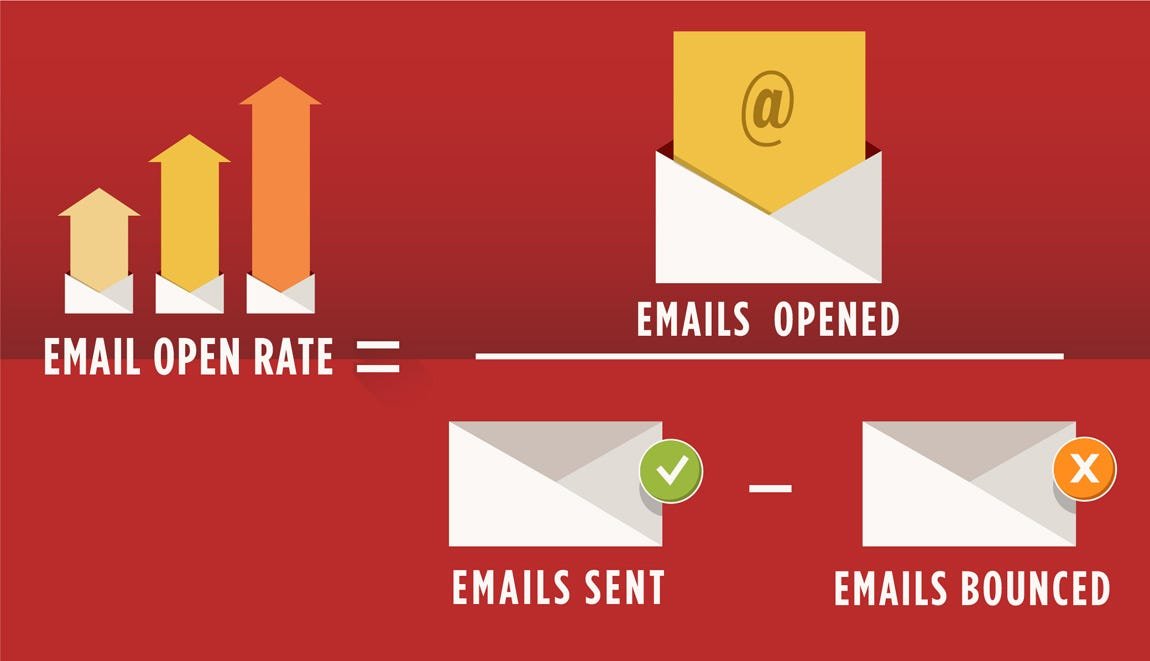
Email open rate measures the percentage of recipients who open a marketing email out of total emails delivered. The calculation divides unique opens by emails delivered (excluding bounces), then multiplies by 100. For example, if 950 emails are delivered and 200 are opened, the open rate is 21%. Technically, an “open” is tracked when a recipient’s email client loads an invisible tracking pixel embedded in the email.
Factors Influencing Open Rates
Multiple variables determine whether recipients open emails. Subject lines are most critical, with compelling copy creating curiosity or clear value increasing by 20-30%. Send timing significantly impacts performance, as emails arriving when recipients check their inbox naturally receive more attention. Sender reputation determines whether emails reach inboxes or spam folders, influenced by sending patterns, complaint rates, and proper authentication.
The Impact of Apple Mail Privacy Protection
Apple’s Mail Privacy Protection (MPP), introduced in 2021, fundamentally changed open rate measurement by preloading tracking pixels before users actually open emails. This inflated reported open rates by 10-20% overnight, particularly affecting consumer brands with high iOS penetration. Marketers now rely more on click-through rates and conversions as MPP makes open rates less reliable for measuring true engagement.
Average Email Open Rate Benchmarks by Industry (2025 Data)
Understanding email open rate benchmarks by industry helps marketers evaluate whether their campaigns are performing above or below average. Open rates vary significantly depending on audience type, content relevance, and communication frequency.
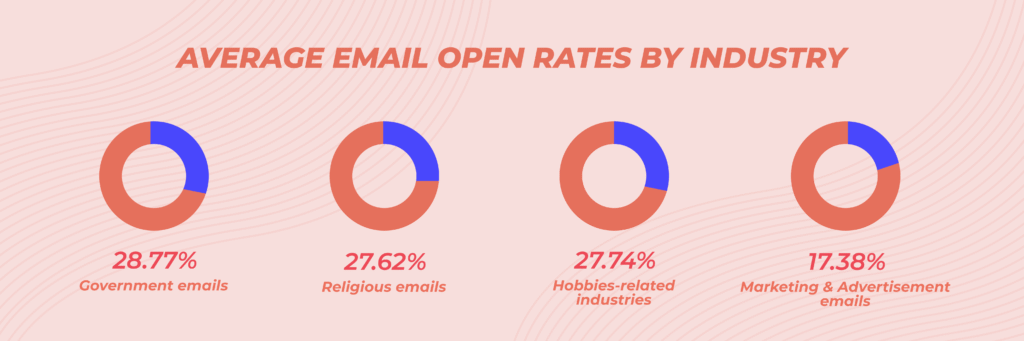
Here’s a snapshot of average email open rate benchmarks across industries in 2025:
| Industry | Average Open Rate (2025) | Source |
| Nonprofits | 39.7% | Campaign Monitor, 2025 |
| Education | 36.4% | Campaign Monitor, 2025 |
| Healthcare | 34.2% | Mailchimp, 2025 |
| Real Estate | 31.6% | HubSpot, 2025 |
| Finance & Insurance | 28.9% | Mailchimp, 2025 |
| E-commerce | 24.8% | Campaign Monitor, 2025 |
| Technology (SaaS) | 26.3% | HubSpot, 2025 |
| Travel & Hospitality | 23.4% | Mailchimp, 2025 |
Analysis:
- Nonprofits and educational institutions continue to lead with the highest engagement rates, thanks to mission-driven storytelling and community-driven content.
- E-commerce and travel brands, while having lower open rates, often compensate through high click-through and conversion rates due to visually appealing and time-sensitive campaigns.
- Technology and finance sectors maintain steady engagement as they leverage automation and AI-powered personalization.
Key statistics
1. The average email open rate across all industries is 21.33%.
This benchmark, reported by Mailchimp (2025), serves as the global baseline for evaluating email campaign success. Campaigns performing above this rate indicate effective subject lines, good sender reputation, and strong audience engagement.
Source: Mailchimp Email Marketing Benchmarks 2025
2. Segmented email campaigns see a 14.31% higher open rate than non-segmented campaigns.
According to HubSpot, marketers who segment their email lists based on audience behavior or demographics achieve significantly better engagement without extra cost. Personalization remains one of the most powerful ways to boost open rates and conversions.
Source: HubSpot Marketing Statistics
3. Personalized subject lines can increase open rates by up to 26%.
Campaign Monitor’s 2025 report shows that personalization continues to be a major driver of email engagement. Including recipient names or relevant details in the subject line increases visibility and encourages clicks.
Source: Campaign Monitor Email Marketing Benchmarks
4. Mobile devices account for 46% of all email opens.
This figure highlights the importance of mobile-friendly design and concise subject lines. Emails optimized for smaller screens tend to achieve higher open and click-through rates.
Source: Drip 2024 Email Marketing Statistics
5. Emails sent on Tuesdays have the highest average open rate of 18%.
According to Campaign Monitor, Tuesday continues to be the most effective day for email engagement, outperforming weekends and Mondays. Marketers can schedule important campaigns mid-week for optimal visibility.
Source: Campaign Monitor Best Time To Send Email Campaigns
6. Welcome emails generate an average open rate of 68.6%.
This makes them one of the highest-performing types of emails. Brands that use automation to send welcome messages immediately after sign-up see stronger engagement and long-term retention.
Source: Mailmodo Welcome Email Statistics
Strategies to Improve Your Email Open Rates
To outperform 2025’s email open rate benchmarks by industry, marketers need to combine creativity, timing, and data-driven optimization. Below are actionable strategies supported by current best practices:
1. Craft compelling, personalized subject lines
Research from HubSpot shows that personalized subject lines can improve open rates by up to 26%. Addressing recipients by name or referencing their behavior makes emails feel tailored and relevant.
2. Optimize send times
Test different delivery schedules. For most industries, midweek mornings (especially Tuesdays and Wednesdays) yield the highest engagement, but your audience data should guide your final decision.
3. Segment your audience
According to Mailchimp, segmented email campaigns achieve over 14% higher open rates. Group subscribers by interest, purchase history, or engagement level to deliver more relevant content.
4. Maintain list hygiene
Remove inactive subscribers periodically. High bounce or unengaged rates can harm sender reputation and deliverability, ultimately reducing open rates.
5. Use A/B testing to refine subject lines and timing
Test small variables such as tone, emoji use, or email preview text. Data from these experiments can help fine-tune messaging for optimal performance.
6. Ensure mobile optimization
Nearly half of all email opens now occur on mobile devices. Use concise subject lines (under 40 characters) and ensure emails render properly on different screen sizes.
Conclusion
Understanding email open rate benchmarks by industry helps marketers evaluate campaign performance with realistic context. Instead of guessing what “good” looks like, brands can now compare their metrics against proven standards. Businesses that analyze open rates, experiment with personalization, and continuously test subject lines are more likely to see growth in engagement and conversions. In 2025, success in email marketing will depend on how effectively you blend creativity, segmentation, and automation to reach audiences at the right moment.
FAQs (Frequently Asked Questions)
What is a good email open rate in 2025?
A good email open rate varies by industry but generally falls between 20% and 25%. Some industries, such as education and nonprofits, may see higher averages.
Why do open rates differ across industries?
Each industry has unique audience behaviors, communication styles, and levels of brand familiarity. For example, niche or highly engaged audiences typically yield higher open rates than broader B2C sectors.
How can I improve my email open rate quickly?
Focus on creating engaging subject lines, segmenting your audience, and sending emails at optimal times based on past engagement data.