

Artificial intelligence is no longer just a buzzword — it’s now deeply embedded in the way companies handle customer service and lead generation. By 2025, AI chatbots have become a cornerstone of customer engagement, allowing organizations to scale support, improve response times, and drive sales more efficiently than ever.
According to DemandSage, more than 987 million people globally are using AI chatbots as of 2025. The global AI chatbot market is also projected to hit US$10.32 billion this year.
In this article, we explore the best AI chatbots for customer service and lead generation in 2025, explain why businesses are increasingly leaning on these tools, and highlight the top chatbot platforms reshaping digital engagement.
What Makes a Good AI Chatbot in 2025?
With rapid innovation in AI, not all chatbots are created equal. A truly effective chatbot today needs to combine several advanced features — and leveraging the right ones can significantly improve both customer service and lead generation.
1. Advanced Conversational Intelligence
Modern AI chatbots deploy sophisticated natural language understanding (NLU) and large language models (LLMs) to interpret user intent accurately. These conversational AI tools enable bots to have meaningful, context-aware conversations. As LLMs like GPT-series become more powerful, chatbots deliver human-like, personalized interactions.
2. Omnichannel Presence
In 2025, it’s critical for a chatbot to operate seamlessly across multiple channels — not just on a website, but in messaging apps like WhatsApp, Messenger, and even SMS or email. These omnichannel chatbots ensure that customers get consistent help no matter where they engage with the business.
3. Intelligent Lead Qualification
For businesses focused on growth, chatbots must do more than just answer basic queries — they need to help capture and qualify leads. Top AI chatbots ask relevant questions, analyze user responses, and prioritize high-intent prospects. In fact, a study showed that 55% of enterprises reported an increase in high-quality leads after deploying AI chatbots.
4. Deep Integration with Business Systems
A powerful chatbot doesn’t operate in isolation. Integration with CRMs (like HubSpot or Salesforce), e-commerce platforms, and ticketing systems is essential. That way, the bot can pull in customer data, update records, and personalize conversations dynamically.
5. Automation & Decision Logic
Modern AI chatbots go beyond static scripts. They execute automated workflows: booking appointments, routing complex cases to human agents, escalating tickets, or even processing transactions. This makes them not just a tool for answering questions, but a strategic assistant.
Why Businesses Need AI Chatbots for Customer Service in 2025
The adoption of AI chatbots in customer support isn’t just a tech trend — it’s driven by tangible business needs and results.

1. Cost Efficiency & Automation
Companies that deploy AI chatbots report substantial cost savings. Many businesses have seen their customer support costs fall by up to 30% through chatbot automation. These savings come from automating routine tasks and reducing the need for large support teams.
2. Around-the-Clock Availability
Unlike human agents, chatbots never sleep. They provide 24/7 support, meeting customer expectations for instant responses regardless of time zones or business hours. According to Digippl, 64% of consumers value chatbots because of their always-on availability.
3. Faster Response Times & Better Experience
Speed is a big deal. Chatbots can typically respond in seconds — studies suggest they can answer in under 5 seconds — compared to the average 12-minute wait for humans. This rapid feedback boosts customer satisfaction, especially for simple, repetitive queries.
4. Enhanced Productivity for Human Agents
By handling FAQs and routine tasks, chatbots free up human agents for more complex, high-value interactions. They also route conversations intelligently, ensuring that customers with more advanced problems reach the right person faster.
5. High Adoption & ROI Confidence
AI-powered customer service is not just for big companies: 78% of enterprises are already using AI in at least one business function, according to FullView. And according to Mailmodo, 74% of organizations using AI chatbots report increased revenue, with 87% seeing reduced agent effort, and 92% experiencing faster issue resolution.
How AI Chatbots Drive Lead Generation in 2025
AI chatbots are not only supporting customers — they’re actively generating and nurturing leads.
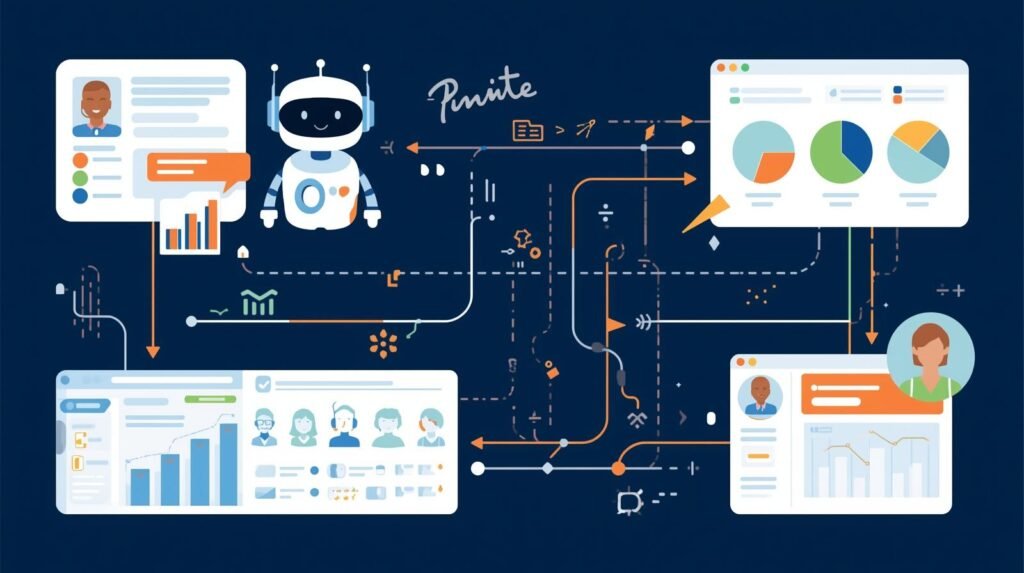
Here’s how:
1. Conversational Lead Capture
Chatbots engage visitors in real-time, turning passive website visitors or social media users into active participants. Rather than filling out boring forms, users answer questions in a conversational flow — which often feels more natural and less intrusive.
2. Lead Qualifying & Scoring
AI chatbots use decision logic to ask targeted questions: What’s your budget? When do you plan to buy? Are you a decision-maker? Based on responses, they score leads, helping sales teams prioritize follow-ups. According to research, 55% of companies saw a meaningful uptick in high-quality leads after implementing chatbots.
3. Personalized Recommendations
Thanks to integration with customer data and behavioral analytics, modern chatbots can make product or content recommendations tailored to each user’s context. This level of personalization increases engagement and the likelihood of conversion.
4. Automated Nurturing & Follow-ups
After qualifying a lead, chatbots don’t abandon the conversation. They follow up automatically — sending reminders, booking demos, or sharing helpful content — keeping prospects warm without manual intervention.
5. Sales Tool Integration
To make the lead journey seamless, chatbots integrate with major sales platforms such as HubSpot, Salesforce, or Pipedrive. This ensures that all captured leads are properly logged, tracked, and followed up within the sales pipeline.
Adoption Landscape: AI Chatbot Market & Usage in 2025
Understanding the broader market helps illustrate why AI chatbots are so central to business strategies in 2025.
- The global AI chatbot market is projected to grow strongly; Global Growth Insights estimates it will reach US$13.78 billion in 2025, up significantly from prior years.
- According to SEO Sandwitch, 78% of enterprises are deploying at least one chatbot solution in 2025.
- On application breakdown, customer service remains the top use case, accounting for over 42% of total chatbot usage.
- In sectors like banking, chatbots are deeply embedded. For instance, 78% of Tier-1 customer queries in banking are now handled by AI agents, according to AI chatbot research.
Top 7 Best AI Chatbots for Customer Service and Lead Generation in 2025
The AI chatbot market is crowded, but a few platforms lead the way in 2025. Below are the top chatbot solutions:
1. ChatGPT Omni (OpenAI)
ChatGPT Omni is one of the most advanced conversational AI tools available. With its powerful reasoning, multilingual support, and natural language capabilities, it’s ideal for businesses needing both customer service automation and lead generation support.
Key Features:
- Human-level conversation
- Advanced personalization
- API integration with apps like Slack, WhatsApp, and websites
- Can function as both an AI support agent and a lead qualification chatbot
Best For:
Businesses wanting a flexible and highly intelligent assistant for a wide range of tasks.
2. Intercom Fin AI
Intercom’s Fin AI is designed for businesses that handle a high volume of customer inquiries. It focuses on automating conversational support while preserving a smooth customer experience.
Key Features:
- Smart routing to human agents
- Knowledge-base integration
- Omnichannel engagement
- Strong analytics dashboard
Best For:
Companies looking to modernize their customer support with a tool that learns from real interactions.
3. Drift AI
Drift is one of the best chatbot lead generation tools in the market. It specializes in conversational marketing and is built to help businesses speed up sales cycles.
Key Features:
- Automated lead qualification
- Personalized chatbot playbooks
- Integration with major CRMs
- Conversational landing pages
Best For:
Sales-driven businesses that want to boost conversions and optimize their marketing funnel.
4. Tidio AI
Tidio AI has become one of the most popular chatbot platforms for small and medium-sized businesses. It combines AI-powered automation with live chat, making it ideal for brands that want a hybrid support system.
Key Features
- AI responses powered by proprietary LLMs
- Integrated live chat for human handoff
- Automated lead capture and follow-ups
- Prebuilt chatbot templates for e-commerce, SaaS, and service businesses
A 2024 performance study revealed that businesses using Tidio reported a 29% increase in customer satisfaction, especially when combining automation with human support workflows. Tidio’s AI engine also handles up to 70% of repetitive questions, reducing staff workload significantly.
Best For
Small and mid-sized businesses wanting an affordable, beginner-friendly AI chatbot with strong customer service capabilities.
5. HubSpot Chatbot Builder
HubSpot remains a dominant player in CRM and customer engagement, and its AI chatbot builder integrates directly with the HubSpot ecosystem. This makes it extremely powerful for businesses relying on organized marketing, sales, and service pipelines.
Key Features
- Deep CRM integration
- Automated lead qualification
- Conversation routing based on workflows
- Built-in analytics and customer tracking
HubSpot reports that companies using automation tools in their CRM — including AI chatbots — experience 80% higher lead-to-close rates and 3× faster response times. The platform also provides customer timeline tracking, enabling chatbots to deliver more personalized, data-driven interactions.
Best For
Businesses that want an all-in-one CRM + chatbot environment for managing sales, marketing, and customer service.
6. Freshchat AI (Freshworks)
Freshchat AI is designed for enterprise-level support and combines machine learning with intuitive customer engagement. Its strength lies in scaling customer interactions without sacrificing accuracy or personalization.
Key Features
- AI-powered knowledge base integration
- Predictive support suggestions
- Automated incident resolution
- Unified messaging (web, mobile, WhatsApp, and email)
According to Freshworks’ 2024 Customer Engagement Report, companies using Freshchat AI experience:
- 50% reduction in support ticket volume
- 30% faster resolution times
- Significant cost savings across large support teams
Best For
Medium to large enterprises looking for scalable customer service automation with strong AI capabilities.
7. Zoho SalesIQ Zobot
Zoho’s Zobot is one of the most customizable chatbots in the market. It’s particularly powerful for lead generation because of Zoho’s robust CRM ecosystem and built-in analytics.
Key Features
- Code and no-code chatbot builder
- Website visitor tracking
- Lead scoring automation
- Integration with Zoho CRM, Mail, Social, and Sales tools
Zoho’s official reports show that businesses using Zobot experience up to 40% improvement in lead qualification accuracy and save hundreds of hours annually in manual lead processing. This makes it ideal for digitally mature companies looking for data-driven decision-making.
Best For
Businesses already using Zoho products or companies seeking highly customizable chatbot automation.
AI Chatbot Comparison: Features, Pricing, and Best Use Cases (2025)
To help you choose the right AI chatbot for your business, we’ve created a side-by-side comparison of the top tools in 2025.
The table highlights each chatbot’s best use case, key features, pricing, pros, and cons — making it easier to pick the one that fits your customer service and lead generation needs.
| Chatbot Tool | Best For | Key Features | Pricing (2025) | Pros | Cons |
|---|---|---|---|---|---|
| Intercom Fin AI | Customer service + multi-channel automation | AI agent replies, ticket routing, help center automation, CRM integrations | From $39/mo (Starter) | Highly accurate AI responses, strong CRM and support tools | Can get expensive for large teams |
| Zendesk AI | Scaling support teams | AI agent assistant, automated workflows, omnichannel support | From $69/mo | Extremely reliable, trusted by big brands | Requires setup knowledge |
| Drift | Lead generation + B2B sales | AI sales assistant, lead qualification, revenue acceleration tools | Custom pricing | Best for enterprise sales funnels | Higher cost, not beginner-friendly |
| HubSpot Chatbot | All-in-one marketing + sales | CRM integration, lead capture, email automation, workflows | Free (basic) | Perfect for startups, no extra cost | AI features limited without paid HubSpot tiers |
| Tidio AI (Lyro) | Small businesses + eCommerce | AI agent, automated answers, Shopify/WooCommerce integration | Free plan; $29–$49/mo for AI | Easy to use, fast setup | AI accuracy slightly lower than Intercom |
| ManyChat | Social media lead generation | Instagram + Facebook automation, flows, broadcasts | Free plan; paid from $15/mo | Best for IG/FB marketing | Not ideal for website support |
| Chatfuel AI | WhatsApp + social chat marketing | WhatsApp automation, AI flows, message campaigns | From $15/mo | Great for WhatsApp businesses | Not designed for deep support tasks |
| Freshchat by Freshworks | Customer service in startups | AI-driven support, multi-channel chat, bot-builder | From $23/mo | Affordable and powerful | Less advanced analytics than rivals |
| LiveChat + ChatBot | Customer service + sales | Drag-and-drop bot builder, prebuilt templates | From $20/mo + bot add-on | Strong hybrid human+AI setup | Pricing adds up when combining products |
AI Chatbot Trends to Expect in 2025
2025 marks a major shift in how AI chatbots are designed and deployed. The following trends are defining the future of digital interaction:
1. Rise of Autonomous AI Agents
Chatbots are no longer just responding to queries — they are taking actions. New AI agents can update databases, resolve tickets, create tasks, or notify teams using autonomous decision-making models. Gartner predicts that by 2026, 30% of customer service teams will run on fully autonomous AI support agents.
2. Voice-Based Customer Service
The global voice AI market is expanding rapidly. By the end of 2025, voice bots are projected to handle more than 50% of customer phone interactions in certain sectors such as banking, telcos, and health care. This trend is driven by rising adoption of voice assistants like Alexa, Google Assistant, and enterprise speech technologies.
3. Hyper-Personalization
AI chatbots now use real-time analytics to personalize conversations based on:
- browsing behavior
- purchase history
- location
- customer sentiment
According to Accenture, personalization increases conversion rates by up to 33% when used correctly.
4. AI-Powered Predictive Support
Instead of waiting for customer complaints, chatbots predict potential issues based on usage patterns and trigger early interventions — reducing churn.
How to Choose the Right AI Chatbot for Your Business
Selecting the right chatbot depends on your goals, industry, and customer expectations.
1. Define Your Primary Use Case
Are you focusing on:
- Customer service?
- Lead generation?
- Sales automation?
- E-commerce recommendations?
For example:
- Drift → Best for lead generation
- Intercom AI → Best for customer service
- HubSpot → Best for CRM-driven companies
2. Check Integration Compatibility
Your chatbot must integrate with your existing stack. If your business runs on WordPress, Shopify, HubSpot, or Salesforce, ensure your chosen chatbot offers direct or API-based integration.
3. Evaluate AI Capabilities
A modern chatbot must support:
- natural language understanding
- sentiment detection
- automated workflows
- real-time learning
- data extraction
4. Consider Pricing and Scalability
AI chatbot pricing varies significantly. Enterprise AI systems like Intercom or Freshchat cost more but scale well. Tools like Tidio or Zoho suit smaller budgets.
5. Review Performance Analytics
Make sure the platform offers insights into:
- customer satisfaction
- automation rate
- conversion rate
- agent workload reduction
Companies that use chatbots with analytics features see up to 40% improvement in decision-making accuracy according to a 2024 Zendesk study.
Short Buyer’s Guide Table
| Business Type | Recommended Chatbot | Why |
|---|---|---|
| Small business / eCommerce | Tidio AI (Lyro) | Affordable, easy setup, works with Shopify/WooCommerce |
| Medium business | Intercom Fin AI | Best blend of automation + CRM + multi-channel support |
| Enterprise / SaaS | Zendesk AI | Scalability, reliability, deep support tools |
| Social media marketing | ManyChat | #1 for Instagram and Facebook automation |
| WhatsApp business | Chatfuel AI | Optimized for WhatsApp lead generation |
| Sales-led B2B teams | Drift | AI-powered qualification and conversion tools |
| Startups on a budget | HubSpot Chatbot | Free, integrated with HubSpot CRM |
Conclusion
As we move deeper into 2025, AI chatbots are becoming indispensable tools for businesses that want to deliver exceptional customer service and generate high-quality leads at scale. With the global chatbot market expected to surpass US$13 billion, organizations that adopt intelligent, automated, and personalized customer engagement will have a significant competitive advantage.
Whether you choose ChatGPT Omni, Intercom Fin AI, Drift, Tidio, HubSpot, Freshchat AI, or Zoho Zobot, the key is finding the right solution tailored to your business needs.
Which AI chatbot is best for small businesses?
Tidio and Chatfuel are excellent for small businesses because they are cost-effective, easy to set up, and include built-in templates for support and sales automation.
Can AI chatbots replace human customer service agents?
Not fully. Chatbots handle repetitive queries and quick responses, while humans handle complex emotional or high-risk situations. Together, they create a hybrid support model.
How do AI chatbots generate leads?
AI chatbots generate leads by automatically collecting emails, qualifying prospects with smart questions, offering instant responses, and routing hot leads to sales teams.
Are chatbots safe to use for customer data?
Yes—when using reputable platforms with encryption, GDPR compliance, and secure cloud hosting. Always review a chatbot’s privacy policy before integration.
What industries use AI chatbots the most in 2025?
E-commerce, fintech, healthcare, digital education, travel, SaaS, and real estate are among the top industries using chatbots for engagement and conversion.