
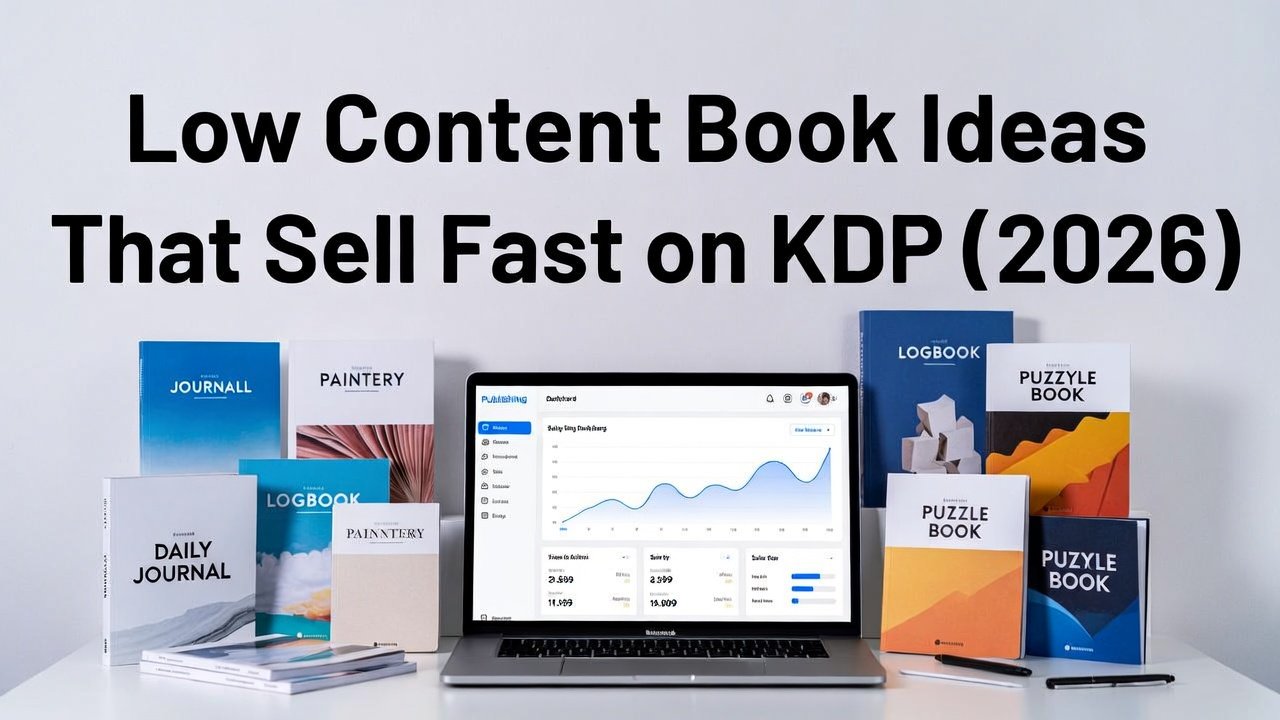
What are the best low content book ideas that can actually make you money on Amazon KDP?
If you’re looking for one of the fastest ways to make money on Amazon KDP, low content books are where I always tell beginners to start.
Why?
Because you don’t need to write 200 pages. You don’t need to be a professional author. And you can publish multiple books in a short time.
I’ve personally published low content books that started getting sales within days — but here’s the catch: not all low content books sell. The winners are always backed by solid keyword research and smart niche selection.
In this guide, I’ll show you low content book ideas that actually sell fast on KDP in 2026, plus how to pick the right one.
Table of Contents
What Are Low Content Books on Amazon KDP?
Low content books are books with minimal written content. Instead of heavy text, they focus on structured pages that users fill in or interact with.
Common examples include:
- Journals
- Planners
- Logbooks
- Activity books
They’re popular because they solve simple problems — and people buy them every day.
If you’re completely new to publishing, I recommend starting with this full beginner walkthrough 👉 How to Self-Publish a Book on Amazon KDP in 2026.
Why Low Content Books Sell Fast on KDP
From my experience, low content books sell faster for three main reasons:
1. High demand, evergreen use
People always need journals, planners, and trackers.
2. Faster production time
You can create and publish in a day or two.
3. Scalable income model
Instead of one book, you can build a catalog of 10–50 books.
But to succeed, you need to validate your niche properly. This is where most beginners fail.
To shortcut the process, I use tools like SelfPublishing Titans to find profitable keywords and low-competition niches.
Best Low Content Book Ideas That Sell Fast in 2026
Let’s get into the ideas that are working right now.
1. Gratitude Journals (High Demand KDP Niche)
Gratitude journals are evergreen.
People are constantly searching for:
- “gratitude journal for women”
- “daily gratitude journal”
To stand out:
- Target a specific audience (e.g., moms, teens, Christians)
- Add guided prompts
2. Fitness and Workout Log Books
Fitness is a massive niche.
Examples:
- Gym workout tracker
- Weight loss journal
- Home workout planner
These sell well because they help users track progress — and people love measurable results.
3. Budget Planners and Expense Trackers
Money management never goes out of style.
Popular variations:
- Monthly budget planner
- Debt payoff tracker
- Savings challenge book
This niche converts well because it solves a real financial problem.
4. Daily Planners and Productivity Journals
These are some of my best-performing books.
Ideas include:
- Undated daily planner
- Goal-setting journal
- Time-blocking planner
Pro tip: Combine productivity with a niche (e.g., “student planner” or “entrepreneur planner”).
5. Puzzle Books (Low Competition Goldmine)
Puzzle books are underrated.
Examples:
- Sudoku books
- Word search puzzles
- Crossword puzzles
They’re especially profitable because:
- People buy them repeatedly
- They appeal to all age groups
6. Coloring Books for Adults and Kids
Coloring books continue to trend.
Top angles:
- Stress relief coloring books
- Kids educational coloring books
- Themed designs (animals, mandalas, affirmations)
Design quality matters a lot here.
7. Logbooks (Simple but Profitable)
These are some of the easiest books to create.
Examples:
- Password logbook
- Vehicle maintenance log
- Food journal
They solve very specific needs — which makes them easier to rank.
8. Affirmation Journals
Mental wellness is booming.
Ideas:
- Self-love journal
- Confidence journal
- Manifestation journal
Pair this with strong keywords and a clean design, and it can perform very well.
9. Travel Planners and Journals
Travel is back and growing.
Examples:
- Travel itinerary planner
- Bucket list journal
- Vacation memory book
These do especially well during peak travel seasons.
10. Niche-Specific Journals (The Secret to Fast Sales)
This is where the real money is.
Instead of generic journals, go niche:
- “Pregnancy journal for first-time moms”
- “Football training logbook”
- “Teacher lesson planner”
The more specific your audience, the less competition you face.
To find these hidden opportunities, I highly recommend checking this SelfPublishingTitans Review Article.
How to Choose the Best Low Content Book Idea
Don’t just pick randomly. Use this simple framework:
1. Demand – Are people searching for it?
2. Competition – Can you realistically rank?
3. Audience – Is it specific enough?
I learned this the hard way. My first few books didn’t sell because I skipped proper research.
Now, every book I create starts with keyword validation using tools like SelfPublishing Titans.
Final Thoughts: Start Simple, Then Scale
Low content publishing isn’t about creating one perfect book.
It’s about:
- Testing ideas
- Learning what works
- Scaling your winners
If you’re just getting started, don’t overthink it.
Pick one idea from this list, validate it, and publish your first book.
Then come back and refine your strategy using this guide 👉 How to Self-Publish a Book on Amazon KDP in 2026.
FAQs About Low Content Books on KDP
1. What is the most profitable low content book?
It depends on demand and competition, but journals, planners, and logbooks consistently perform well.
2. Can beginners succeed with low content books?
Yes. In fact, it’s one of the easiest entry points into self-publishing.
3. How many low content books should I publish?
Start with 3–5, then scale to 10+ as you learn what sells.
4. Do I need design skills to create low content books?
No. You can use templates and tools to simplify the process.